General Woodwind Auditions
Undergraduate audition/tape material should be 10-15 minutes in length. For live auditions there may be 2-4 woodwind area faculty present. For pre-recorded auditions YouTube or file links are preferred. An accompanist is not required.
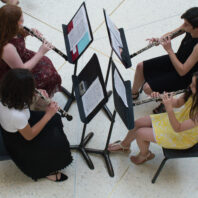
Graduate audition materials should be 20-25 minutes in length. For live auditions, an accompanist is not required; there may be 2-4 woodwind area faculty present. For pre-recorded auditions, accompanists are recommended but not required. YouTube or file links are preferred.
General Requirements
- All major scales
- Fast etude or solo
- A lyrical slow etude or solo
- Sight reading may be requested at the audition
Flute Audition Requirements
Undergraduate
- Major scales in two octaves (three octave C Major recommended)
- Fast etude or solo
- A lyrical slow etude or solo
Graduate
- One orchestral excerpt from the following list:
- Debussy’s Prélude à l’après-midi d’un faune (Beg. – Reh. 3)
- Brahms’ Symphony No. 4, Movement 4 (m. 89–105)
- Ravel’s Daphnis et Chloé (Reh. 176 – 2 after Reh. 179)
- Two-three works, or movements from those works, that are from different style periods and show both lyrical and technical skills. The repertoire below are suggestions to determine skill level only, they are not requirements. Diversity of repertoire is encouraged and appreciated.
- A Mozart Concerto, Bach or Bon sonatas, any major 20th-century sonata or concerto, Dutilleux’s Sonatine, Coleman’s Danza de la Mariposa, Hailstork’s Yuhwa, etc.
If you have questions about repertoire selection, please contact Dr. Tegart via email at sophiat@wsu.edu
Oboe Audition Requirements
- Major scales
- Fast etude or solo
- A lyrical slow etude or solo
If you have questions about repertoire selection, please contact Dr. McCarthy via email at kmccarthy@wsu.edu
Clarinet and Bass Clarinet Audition Requirements
Undergraduate
- Major Scales in two octaves (three octaves recommended for scales E, F, F#, & G)
- Fast etude or solo of applicant’s choice. This can be a complete work from the standard repertoire, or a single movement from a larger piece.
- A contrasting, slow etude or lyrical solo of applicant’s choice.
Graduate (non-performance degree track may skip the orchestral excerpts)
- Mozart: Concerto in A Major, KV. 622, mvt. 1, exposition
- Two contrasting orchestral excerpts chosen from the following:
- Brahms Symphony #3, mvt. 2 (beginning through B)
- Beethoven Symphony #6, mvt. 2 (D through end of m. 77)
- Mendelssohn Scherzo from “A Midsummer Night’s Dream” (beginning through B)
- Rimsky-Korsakov: Capriccio Espagnol, mvt. 1 (beginning through B)
- Two works that show both lyrical and technical skills.
- One must be an original work for clarinet written before 1950.
- The second, must be written after 1950.
Diversity and inclusion of repertoire from traditionally underrepresented groups is always appreciated.
If you have questions about repertoire selection, please contact Dr. Rice via e-mail at kathryn.e.rice@wsu.edu
Bassoon Audition Requirements
Undergraduate
- Major scales in two octaves
- Fast etude or solo
- A lyrical slow etude or solo
Graduate
- One unaccompanied piece or etude
- Two contrasting movements from a standard concerto or sonata (Mozart, Weber, Saint-Saëns, etc.)
- An additional work of the applicant’s choice that represents a stylistic contrast to their other audition repertoire
If you have questions about repertoire selection, please contact Dr. Wilson via e-mail at jacqueline.wilson1@wsu.edu
Saxophone Audition Requirements
- Major scales: Full range
- Chromatic Scale: From low Bb to high F (F#)
- Fast etude or solo
- A lyrical slow etude or solo
- For Jazz Majors Only: Jazz improvisation – Improvise on a 12 Bar blues in any key
If you have questions about repertoire selection, please contact Dr. Aaron Hill via e-mail at aaron.hill@wsu.edu